
Showing posts with label Beauty. Show all posts

Thursday, June 16, 2011

Fallacies


I don't want to talk about Anthony Weiner. The man has gotten more than his fair share of press already, and the reports of his tasteless social media interactions make me queasy. However, I do want to talk about his wife, and what some of the comments I've seen floating around in the interwebs about her say about our society's feelings towards women.

This discussion isn't just about Huma Abedin. Inevitably when any high profile man gets caught in some sort of bad behavior that humiliates his spouse*, the talk eventually turns to how beautiful the betrayed wife is or isn't (Tiger Woods is another recent example). Huma Abedin is gorgeous, leading the online community to cry out, "How could he do this to her? She's hot!!" And this is the sort of talk that gets under my skin.

Why is so much emphasis placed on the wife's looks? If she were ugly would his behavior have been more acceptable? If she were merely ordinary-looking would it have made her somehow more deserving of being humiliated and betrayed? Her worth as a human being and her value as a wife are not dependent upon her looks, any more than a misbehaving man's looks are tied to some sort of sliding scale that determines how outraged people ought to be about his behavior.

Whether you feel that Weiner's actions were completely reprehensible or that they merely demonstrated a lack of judgment and incredibly poor taste is beside the point of this discussion. The part of the story that disturbs me is when people focus on the wife's looks as if they're something that needs to be accounted for in the body of evidence.

The other fallacy I've noticed in the online discourse is more subtle: the underlying expectation that beautiful women are supposed to be immune to the hardships of life, that they don't get manipulated and lied to and have their hearts broken just like everybody else. That if you're hot and your husband sexted someone else, then you must be a nagging, overbearing shrew because beautiful women don't get cheated on unless there's something really, really wrong with them. Being beautiful does not endow women with a superhuman ability to detect cheaters; it does not prevent them from falling in love with the wrong person or making bad choices; it does not mean that their spouses will love them more or treat them better.
Beautiful women get betrayed for exactly the same reason that other women do: they get involved with men who are liars and cheats. And that sort of man will lie to and cheat on whoever he's with, no matter what she looks like. A man is either a good man, or he's not; what ultimately saves women from the bad ones is discernment, strength, a belief in one's self, maybe even a little bit of luck. Often these things have to be acquired the hard way, too; beauty may bring other advantages in life, but it won't help in this arena.
Huma Abedin is beautiful. But bringing her beauty into the discussion of her husband's behavior is disrespectful to her as a wife and a woman. Beauty will not help her handle this situation; only her character will.

I'd love to hear your comments. And hey look, I wore clothes today too!

Top: Forever 21
Jeans: Level 99
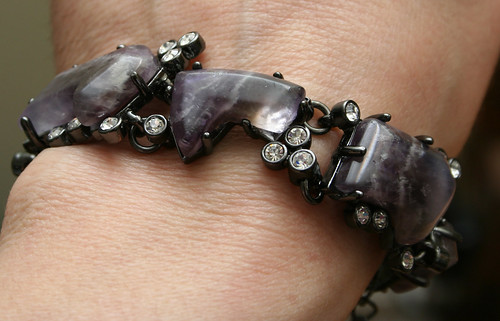
Bracelet: Nicole Miller
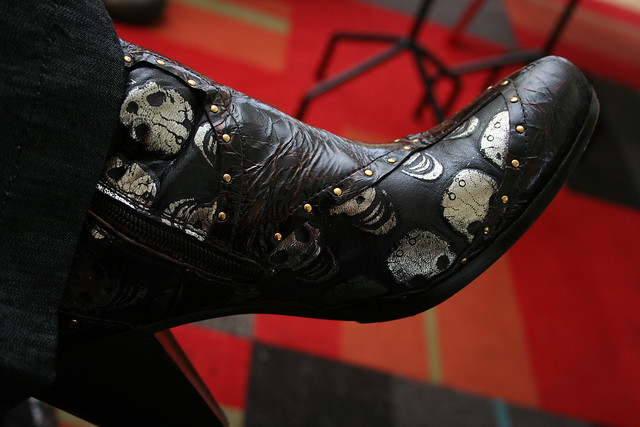
Boots: Jo Ghost

*ETA: I didn't mean to make this a hetero-exclusive discussion; obviously people get hurt in same-sex relationships also, just as wives can sometimes treat husbands badly. But when we're talking about a powerful, high profile person doing something shitty to their spouse, 9 times out of 10 it's a straight man doing it to his wife.

Thursday, November 11, 2010

Savage Beauty by Alexander McQueen


Fall 2008 Collection of Alexander McQueen

The work of the late Lee Alexander McQueen will be the subject of the spring 2011 exhibition at the Costume Institute of The Metropolitan Museum of Art. This exhibition will celebrate McQueen’s contributions to fashion from his Central Saint Martins postgraduate collection in 1992 to his final runway presentation, which took place only weeks after his death in February 2010. Titled Alexander McQueen: Savage Beauty, the exhibition will celebrate the work of  McQueen in challenging and expanding the scope of fashion from mere beautiful clothes to a conceptual expression of culture, politics, and identity.

This exhibition will be on view from May 4 through July 31, 2011 and will be preceded on May 2 by The Costume Institute Gala Benefit. The evening’s Honorary Chairs are François-Henri Pinault and Salma Hayek, and the Co-Chairs will be Colin Firth, Stella McCartney, and Anna Wintour.

Here is an extract of the press release describing what will be on display:


The exhibition, in the Metropolitan Museum’s second-floor Cantor Galleries, will feature approximately 100 examples of Mr. McQueen’s work from his prolific 19- year career. Drawn primarily from the Alexander McQueen Archive in London, with some pieces from the Givenchy Archive in Paris as well as private collections, signature designs including the bumster trouser, the kimono jacket, and the Origami frock coat will be on view. McQueen’s fashions often referenced the exaggerated silhouettes of the 1860s, 1880s, 1890s, and 1950s, but his technical ingenuity always imbued his designs with an innovative sensibility that kept him at the vanguard.


Galleries will showcase recurring themes and concepts in McQueen’s work beginning with “The Savage Mind” which will examine his subversion of traditional tailoring and dressmaking practices through displacement and deconstruction. “Romantic Gothic” will highlight McQueen’s narrative approach to fashion and illuminate his engagement with Romantic literary traditions such as death, decay, and darkness. It will also reveal the main characters of his collections, including femme fatales and anti-heroes such as pirates and highwaymen. “Romantic Nationalism” will look at McQueen’s fascination with the distant past, while “Romantic Exoticism” will examine his focus on distant places. “Romantic Primitivism” will explore McQueen’s engagement with the ideal of the “noble savage.”


Five of McQueen’s landmark collections that explore his engagement with the Romantic sublime and the dialectics of beauty and horror will be interspersed among the galleries -- Dante (autumn/winter 1996-97), Number 13 (spring/ summer 1999), Voss (spring/summer 2001), Irere (spring/summer 2003), and Plato’s Atlantis (spring/summer 2010). “Cabinet of Curiosities” will include various atavistic and fetishized objects often produced with milliner Philip Treacy and jeweler Shaun Leane, longtime collaborators of McQueen’s. A separate screening room will display videos of McQueen’s renowned runway presentations. 

Tuesday, October 5, 2010

The Philosophical Link between Beauty and Death

Dance with the Angel of Death, Pen and Ink Drawing (8x10) by Ingrid Mida 2010

In preparations for my upcoming show at Loop Gallery, I've been doing research into the philosophical link between beauty and death. Contemporary French philosopher Julia Kristeva asked the question of "whether beauty and death are facets of the same experience or perennial opposites" in her book Black Sun: Depression and Melancholia (translated by Leon S. Roudiez and published by Columbia University Press, New York, 1989).

Using Sigmund Freud's essay about the links between grief, transience and beauty as her starting point, Kristeva writes:

"Is beauty inseparable from the ephemeral and hence from mourning? Or else is the beautiful object the one that tirelessly returns following destruction and wars in order to bear witness that there is survival after death?

Kristeva concludes that "beauty represents an artificial, imaginary conquering of death that allows life to continue." 

For me, beauty and death are on the same continuum. When I create something beautiful, I feel as if I've cheated death. But in the world of contemporary art, beauty is not enough. For my upcoming show, I've layered in meaning with references to death in the form of roses (a metaphor for the bloom and decay of human life), clocks (a metaphor for the finite quality of life), and veils (a marker of life's significant passages including weddings and funerals).

Wednesday, July 29, 2009

Book Review: History of Beauty


There is no singular definition of beauty. Through history, the concept of what is considered beautiful has evolved and that changing ideal has been documented by artists, poets and authors. In my quest to understand the concept of beauty, I read the book "History of Beauty" by Umberto Eco.

This monumental tome seeks to answer the questions: What is beauty? What is art? What is taste and fashion? Umberto Eco explores the changing concept of beauty in Western civilization from the ancient Greeks to the present time through extracts from literature, poetry and philosophy as well as paintings, sculptures and photographs.

The seventeen chapters documenting the history of beauty include:
1. The Aesthetic Ideal in Ancient Greece
2. Apollonian and Dionysiac
3. Beauty as Proportion and Harmony
4. Light and Color in the Middle Ages
5. The Beauty of Monsters
6. From the Pastourelle to the Donna Angelicata
7. Magic Beauty between the Fifteenth and Sixteenth Centuries
8. Ladies and Heroes
9. From Grace to Disquieting Beauty
10. Reason and Beauty
11. The Sublime
12. Romantic Beauty
13. The Religion of Beauty
14. The New Object
15. The Beauty of Machines
16. From Abstract Forms to the Depths of Material
17. The Beauty and the Media

One of the most fascinating parts of the book are the comparative tables which visually illustrate and summarize how the concept of beauty has evolved through art over time. For example on the comparative table for "Clothed Venus", the ideal woman is presented from the seventh century BC in the form of a sculpture called Auxerre Kore (Musee de Louvre) and moves through each century to 1960 with Anita Ekberg in La Dolce Vita. Included on this table are some of my favourite artworks such as:
Raphael's La Donna Velata (1514, Galleria Palatina, Palazzo Pitti)
Francois Bouchers Madame de Pompadour (1756, Alte Pinakothek Museum)
Egon Schieles Seated Woman with Brent Knee, (1917, Narodni Galerie)

Other comparative tables include: Nude Venus, Nude Adonis, Clothed Adonis, Face and Hair of Venus, Face and Hair of Adonis, Madonna, Jesus, Kings, and Queens.

One of the most surprising things that I gleened from reading this book is that ugliness is a requirement for beauty. It is in fact the contrast between the two that allows us to recognize beauty. "William of Auvergne said that variety increases the Beauty of the universe, and thus even the things that strike us as unpleasant are necessary to the universal order, including monsters." (page 148)

This is a scholarly book that presents a comprehensive analysis of the ideals of beauty as presented through art and literature. Richly illustrated and written in elegant prose, it should be read by every serious student of art and fashion.


"A beautiful thing is something that would make us happy if it were ours, but remains beautiful even if it belongs to someone else." (page 10)

Title: History of Beauty
Edited by: Umberto Eco
Translated by: Alastair McEwen
Publisher: Rizzoli, New York (2004)
Category: Non-fiction, art
Number of Pages: 438

Monday, May 11, 2009

Beauty in Art

Agnes Martin, Painter (1912-2004)


Is that all?

This is a question that continually pervades my consciousness. Maybe this perpetual state of existential angst is the reason that I am an artist. I am driven to create beauty and to find meaning in what I do.

In the world of contemporary art, art is expected to provoke a reaction. Shock value is prized above an aesthetic that is pleasing to the eye. Beautiful art is considered a sell-out for the sake of commerce. My art has been called "pretty" and "decorative" and is often dismissed before the deeper meaning behind what I make is considered.

In the past few weeks, I've wrestled with the question of whether I could create an artwork (for an invitational competition) that was ugly for the sake of provoking reaction in the viewer. It caused me many sleepless nights and considerable anguish, but in the end, beauty won out, even though the symbolism and deeper meaning were present in the piece.

Agnes Martin(1912-2004) achieved great renown with her abstract paintings of straight lines. Her quietly elegant paintings are owned by the Museum of Modern Art in New York and other museums around the world. I found myself seeking consolation in her comments on art and beauty:

"Beauty and happiness and life are all the same and they are pervasive, unattached and abstract and they are our only concern. They are immeasurable, completely lacking in substance. They are perfect and sublime. This is the subject matter of art."


"When I think of art, I think of beauty. Beauty is the mystery of life. It is not in the eye, it is in the mind. In our minds, there is an awareness of perfection."


What does beauty mean to you?
Can a beautiful work of art create a reaction?


P.S. Coincidentally, today Sallymandy at the Blue Kimono wrote about What is an Artist? .