Showing posts with label Lace. Show all posts

Friday, March 18, 2011

Enamored

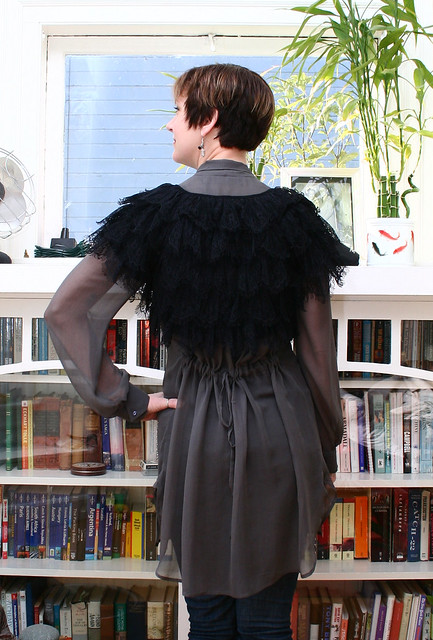
This sheer shirtdress arrived via Gilt just before I left on my trip, so I didn't actually get to wear it until after I got back. And let me just say, I am absolutely enamored with it. The waist can be adjusted by pulling on the ties in the back, so I can control how snug or how loose the dress fits. The sheer silk chiffon feels very elegant, and I just love the way it moves when I walk. I've already got another outfit lined up for next week that uses this dress.

I ended up wearing a variation on this outfit when Laura and I went out to see Peter Murphy in concert (who still sounds amazing after all these years, btw). For our evening out I swapped the jeans for black tights and wore a short black dress (more of a slip, really) instead of the tank I have on here.

To hide all the bra and tank strap action that was visible under the sheer chiffon, I added this lacy shrug. The neckline is just low enough to pair perfectly with the bow at the neck of the dress.
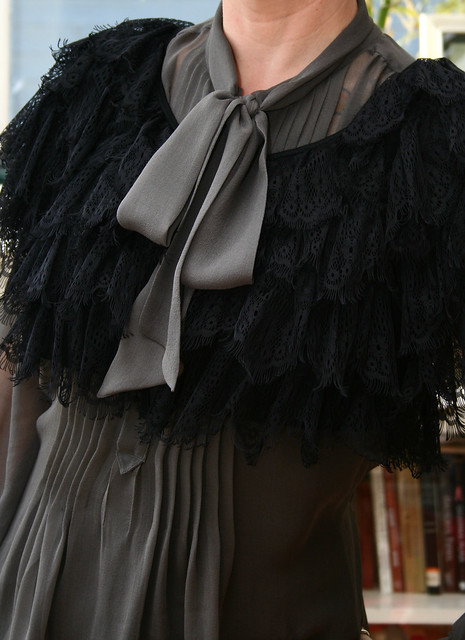


Dress: Fremont
Shrug: a gift from my sister
Jeans: Joe's
Boots: All Black


And because I think everyone could probably use a good laugh on a Friday afternoon, I thought I'd share a video by Canadian comedian Jon Lajoie (how could he not be Canadian with a name like that?), who Jess played for Mark and I when we were up in Seattle. To me the funniest comedy is the kind that points out truths, and this video perfectly sums up exactly how I feel about 99% of music that's played on the radio (which is why I almost never listen to the radio). Be forewarned that the lyrics contain a lot of swearing, so it's NSFW unless you've got headphones.


Wednesday, February 2, 2011

Height Perception

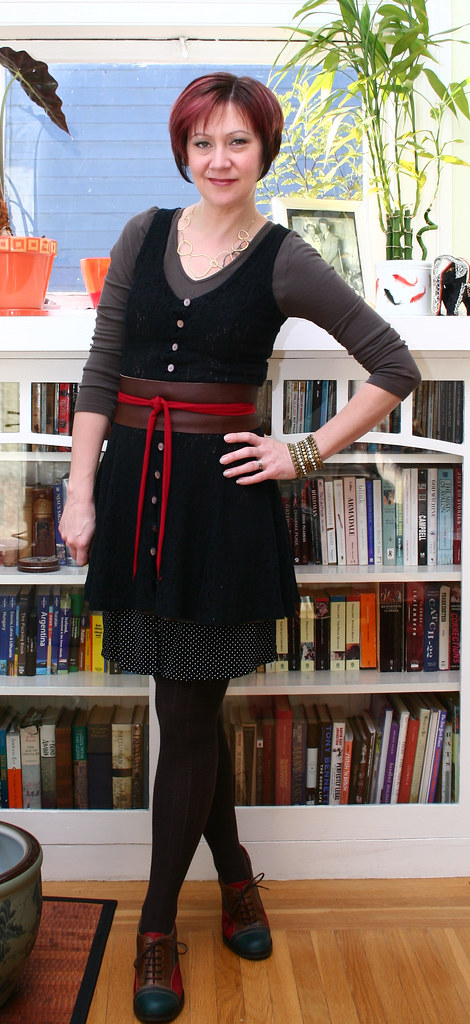
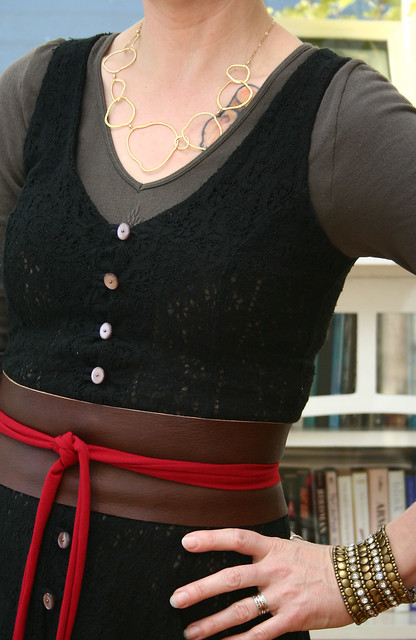
This little lacy black dress is another one Mark and I use a lot for our Etsy shop photos, but that I rarely wear. I've actually owned it since about 1993, but with this season's resurgence in the lace trend, I figured it was high time I pulled it out again. These days I wouldn't wear it as a dress because it's so short (somehow it seemed ok when I was 24, even though it barely covers my butt), but it makes a great layering piece.

I've noticed  from time to time in the comments that people will assume I'm petite, and I wonder why this is. I'm actually 5'8" in bare feet, and the other day I got to thinking that I must subconsciously assume other bloggers are all roughly the same height I am, because I'm surprised if I find out they're considerably taller or shorter. Do we perceive height differently depending on how tall we are ourselves? I wonder also how much of our own body image plays into it; if someone feels they're too short, for instance, does everyone else automatically get perceived as taller, whereas someone who is comfortable with her height (or simply doesn't care) assumes everyone else is the same size?

Why do people care so much about height anyway, other than difficulty in finding clothes that fit? My only gripe about shopping for my own height is that sleeves are often too short, hence I push them up to my elbows a lot. Other than that I wouldn't say I spend much time thinking about it; until of course someone says I'm petite and gets me ruminating on the subject.

How do you perceive the height of people you see on the internet or on TV? How much do you think your own body image plays into those perceptions?   

Brown dress: from Ruby on Haight Street
Black dress: Betsey Johnson
Necklace: from Ambiance on Haight Street
Belt: Audra Jean
Skirt: thrifted and shortened
Bracelet: Leslie Danzis
Tights: Falke
Shoes: Fly London

Friday, July 10, 2009

Nature's lace: The Spider Web


Spider webs are nature's lace.
Their delicacy, fragility and ethereal qualities have inspired my latest artwork.

Photo source: www.Freedigitalphotos.net

For some time, I've wanted to add spider webs to my fashion plates to add a suggestion of decay and an element of whimsy. The interesting thing about trying something new is that I have to make a conscious decision to accept failure as part of the learning process. In other words, I have to be willing to destroy my art and I had to work up my courage.

Along came a spider... A mixed media work by Ingrid Mida, copyright 2009

I was pretty excited after my first attempt. It took about two hours to create one quarter of a web but the metallic thread was so fine that it will not show up in a photograph.

On my second attempt, I added some beads and even then the spider web is still very difficult to see in a photograph. I've been debating whether or not to post my efforts at all. But in person, the effect is just as I hoped for - delicate and other-worldly. It doesn't dominate the piece but adds a soft shimmer from the metallic thread and the beads. You almost don't even notice it until you look more closely. However, I am quite disappointed in how it photographs and am contemplating making a web in black embroidery thread just to better photograph it.

Click on the close-up photo to better see the web!

Sadly my next effort will have to wait. I've cut my hand badly (who said art was relaxing?) and it will need some time to heal.

Monday, July 6, 2009

Lace-making in Bayeux, France

During Louis XIV's reign, his finance minister Jean-Baptiste Colbert undertook to develop and support the luxury goods industry within France. Because Colbert valued retaining monies spent on the purchase of luxury fabrics within France, he helped establish and/or improve existing textile and fashion related manufacturing in the country. These efforts established Bayeux as a lace-making centre.

Bayeux lace is characterized by its delicate patterns based on historical patterns and comes in white, ecru or black.

Photo credit: www.costumes.org

Photo credit: http://dentelledebayeux.free.fr

At its peak, Bayeaux and surrounding villages had in the order of 5000 workers creating bobbin or needle lace. Today there are less than a dozen artisans who create hand-made lace.


Leading the revival of hand-made lace is Marie-Helene Salvador who runs the Atelier du Centre Normand de la Dentelle aux Fuseux in Bayeux. At this centre, she teaches and supervises those who wish to learn the craft of lace-making.

When I stopped in for a visit to observe the lace workers, I was impressed with the skill, dexterity and focus required to create such delicate handwork. I had no idea how the lace-makers knew which bobbin to manipulate and which needle to remove. After seeing them in action, I had a whole new appreciation for the level of craftsmanship in handmade lace. And it didn't surprise me that the beautiful black lace shawl on display took 20 women approximately six months to make. (Sadly no photos were allowed!). Madame Salvador has received national honours for her efforts to revive this dying art.

At the neighbouring museum, Musee Baron Garard Bayeux, there is an extensive collection of Bayeux lace on display including lappets, shawls, collars, cuffs and ruffles. As well, I was delighted to find one of my favourite paintings by Francois Boucher (1702-1770) called The Cage on display as well.

To read more about lace, please see my earlier posts on the subject including:
The Establishment of Lace Making Industry in France
The Lace Sleeve Ruffle

Tuesday, April 28, 2009

Lace in Contemporary Fashion


Photos from Prada shop in London, England, July 2008

This is the last of my posts about lace. Although I intended to write about lace lappets (a relic of fashionable formal headdresses) I found myself yawing at the thought. If I'm bored by the topic, I'm fairly certain you, my loyal readers, will be too.

While I appreciate intricate workmanship that goes into making lace, especially by hand, I don't care to wear it myself. I agree with Monsieur Dior that lace "easily looks old fashioned". I prefer simple elegant lines in my clothing.

Last summer, when the fall 2008 lines were launched, I was quite surprised to see that Muicia Prada had used lace extensively in her collection. To me, the look was dowdy and old-fashioned. I think only gazelle like creatures with long legs and slim waists could carry off the look.

What do you think? Do any of you like to wear lace?

Sunday, April 26, 2009

The Lace Sleeve Ruffle

Detail from a painting of The Marquise d'Aigurandes by F. Drouais, 1759

In eighteenth century France, lace sleeve ruffles were a very important fashion accessory. The sleeve ended just above or just below the elbow to show off the lace ruffle to best advantage. The ruffles could be single, double or treble, with each layer cut to enhance the effect of the lace.

Sleeve ruffles evolved during 18th century (as fashion is wont to do):
Early 1700s: Ruffles are slender and shaped, tapering from a deep central motif.
1720s: Double ruffles are popular.
1730: Shaped ruffles were often attached to muslin upper ruffles.
1750s: The weeping ruffle, which consisted of three layers was introduced.
1780s: Ruffles declined in popularity as the preference for simpler, lightweight, informal styles of dress such as the muslin chemise took hold.


Who knew that lace sleeve ruffles could be such an important accessory?

Friday, April 24, 2009

Dior on Lace


Today on my book blog, Blog of a Bookworm, I reviewed The Little Dictionary of Fashion written by Christian Dior and first published in 1954.

This is what Dior wrote about lace:

"Originally beautiful and expensive handwork, now machinery has made it possible for every woman to have it. I love lace for evening dresses...for a cocktail frock...or for a blouse. I am not so keen on it for trimmings -- it easily looks old fashioned. A little lace collar can look charming on a black frock but it must be chosen with discretion -- you don't want to look like Little Lord Fauntleroy! Under a black suit or with a full skirt for parties, a lace blouse can look charming. But being a rich and elaborate material it should only be used for very simple styles. When a fabric is fancy in itself it needs simplicity of design to show it to its best advantage. It is the same with an evening dress -- choose a style of great simplicity; no complicated drapes or complicated cutting." (page 71)

Thursday, April 23, 2009

The Establishment of a Lace Making Industry in France

Dress c 1690 (Note the profusion of lace trimmings and the lace lappets).

Lace is said to have originated in Venice in the 1300s. Over time, centres of lace-making developed in other parts of Europe including Flanders, Dresden and France.

Designs of early bobbin and needle laces have a strong resemblance to one another due to the creation of pattern books, which were disseminated throughout Europe. The earliest lace pattern book is believed to be from 1524.

Making lace was a labour-intensive process. For example, a pair of men's ruffles made of Valenciennes lace (a type of bobbin lace with the motifs outlined by small pin holes) might take "10 months to produce, based on a 15-hour working day". Not surprisingly, lace was extremely costly.

As the dictates of fashion in the seventeenth century proscribed lace cuffs, ruffs, collars, and trimmings, the demand for Venitian lace (as well as lace from Flanders) resulted in a huge amount of capital flowing out of France. Louis XIV's brilliant finance minister, Colbert, authorized significant investment in a French lace-making industry in Normandy. This site may have been chosen because there was already the beginnings of a lace and braid industry in the Duchy of Alencon.

In 1665, a Royal Ordinance established the manufacture of Points de France with an exclusive right to supply the French Court.

In 1667, the sale or wearing of Venetian lace or any other foreign lace was prohibited in France.

This prohibition was taken very seriously and foreign laces were publicly burned. In 1670, R. Montague said: "They are so set in this country upon maintaining their own manufactures that only two days ago there was publicly burnt by the hangman a hundred thousand crowns worth of point de Venise, Flanders lace and other commodities that are forbid."

Initially, the French copied Italian lace designs. With the high level of Royal patronage, the centres of Alencon and Argentan eventually developed their own styles and characteristics. Alencon often has a horsehair stiffening for the picots (loops) which meant that it was more often used in winter when humidity swelled and stiffened the horsehair. Argentella uses hexagonal mesh, each side of which is worked with buttonhole stitches.

After the French Revolution and the banning of ruffles in 1794, production fell dramatically. Alencon lace continued to be produced in the 19th century.

In May, I will be visiting Normandy, specifically the the Musée Baron Gérard which has an impressive collection of the local lace in both bobbin and needle technique dating back to the 18th century. The collection has household items (tablecloths, doilies, pillows, curtains, bedspreads) as well as garments (infant Christening gowns, wedding veils, dresses and blouses).

Tuesday, April 21, 2009

Lace in 18th Century France

1760 Robe a la francaise with engageantes, quilles, and lappets of lace

In the 18th century, lace was used extensively to enhance the dress of both men and women. For women, lace could adorn the fronts of their robes and gowns (engageantes), the sleeve ruffles (quilles) and lappets on the headdress. Decorative lace aprons were also very popular.

Lace was created using delicate handwork techniques involving either a needle (needle lace or needlepoint lace) or bobbins (bobbin lace).

Needle or needlepoint lace involved a single needle and thread. In its earliest form, lace was created using a piece of fine linen or silk where the threads of the fabric were cut or pulled to form holes and shapes. Those threads were then secured with tiny stitches or embroidered into patterns.

As lace-making developed, another form of needlepoint lace was created whereby the lacemaker pinned a groundwork of linen threads to a parchment strip and the pattern was built up on them with buttonhole stitches. This allowed the lacemaker to break free of a rectilinear pattern and permitted the creation of curved shapes (often found in 17th century laces).

Part of a French needle-lace collar associated with Marie Antoinette, 1780s


Bobbin lace was created by weaving linen threads separated by weighted bobbins around pins stuck in a pattern on a circular pillow. The pins were removed as each section developed and reinserted into the pattern. Between 80 and 200 bobbins had to be manipulated to create the lace patterns, making it the purview of professionals, while needle lace was considered appropriate for the gentlewoman.

Brussels bobbin lace cravat possibly made for Louis XIV

Postscript:
This post was inspired by an inquiry by Melinda who is a student at Missouri Southern State University. To that end, I'll writing about lace all this week. Lappets are worthy of their own post!